
Choosing a bit for your horse is not simply a matter of selecting a model, size or material. The bit works as part of a whole: the anatomy of the horse's mouth, their sensitivities, way of going, level of training, bridle fit, as well as the rider's hand and feel are all factors to consider.
There is therefore no single ideal bit for every horse, nor is there a systematic correlation between a particular behaviour and a specific bit. Instead, the aim is to proceed step by step: observe and identify the characteristics of the current bit, change one parameter when appropriate, then compare the horse's reactions and the rider's feel.
Key point: the choice of bit should be considered for the horse-and-rider partnership. Two horses with similar characteristics may have different preferences and sensitivities, just as the same bit can feel different depending on the rider's hand, its adjustment and the bridle used on the same horse.

Contents
1. Why change your horse's bit?
Changing your horse's bit may be considered for various reasons: the horse is showing signs of discomfort, their training has progressed, the feel of the contact has changed, the horse has damaged the bit, changes have been made to the bridle, or you simply want to check whether another configuration suits the horse-and-rider partnership better.
Discomfort in the horse is the main priority and can manifest itself in different ways: opening the mouth, tongue movements, head shaking, inconsistent contact, a tendency to lean heavily on the bit or, conversely, avoid the contact… These observations are essential, but they are not enough to identify the cause of a difficulty or determine which bit to choose.
A change in behaviour does not necessarily mean that you need to change the bit
The bit is part of a wider picture. Its adjustment, the bridle, the horse's teeth, way of going, the work being asked of the horse and the rider's hand all play a role. If your horse shows an unusual or persistent reaction, it is therefore important not to consider the bit as the only possible explanation.
You should not wait for problems to arise before considering your horse's bit either. Horses evolve throughout their lives and training, just as riders do. A bit that suited the horse at one point can therefore be reassessed, without this necessarily meaning that it was previously unsuitable.
2. The 3 criteria to consider when choosing the right bit
To make it easier to find the bit best suited to your horse-and-rider partnership, we prefer to use a “funnel” approach. Rather than immediately looking for a specific model, it is more useful to analyse the main characteristics of the bit separately:
- The mouthpiece is a good starting point as it is in direct contact with the horse's mouth. Its shape, articulation, thickness and material determine a significant part of the sensations transmitted.
- The cheeks can then be used to adjust the stability of the bit and the way the rein aids are transmitted.
- The alloy or material used for the bit affects several factors in the horse's mouth, including feel and relaxation. It should therefore be chosen according to your horse's sensitivity.
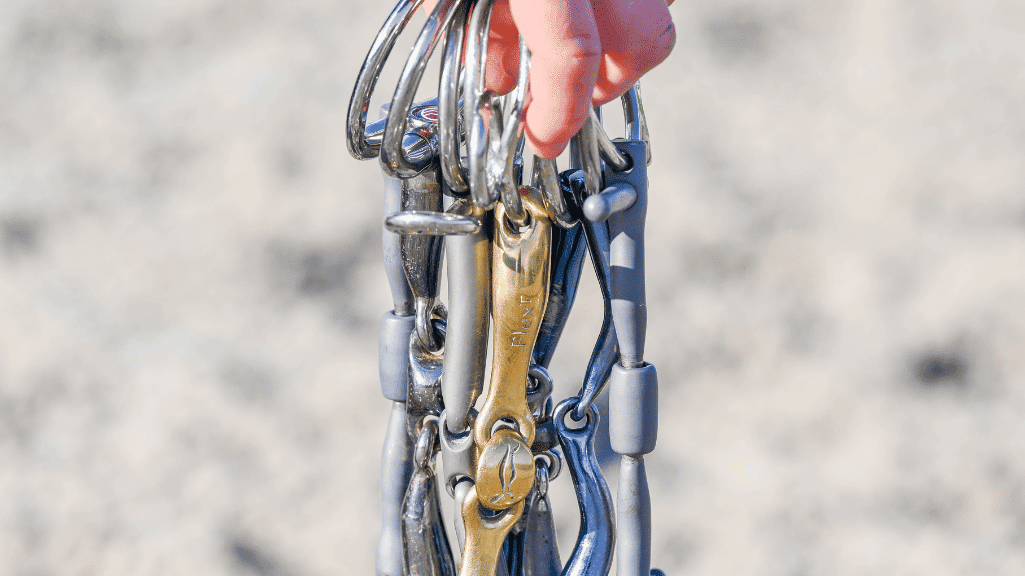
The importance of the mouthpiece
The mouthpiece is the part placed inside the horse's mouth and is the part of the bit that has the greatest impact on comfort and relaxation in the mouth. It is in contact with highly sensitive areas such as the tongue and bars.
When choosing a suitable mouthpiece, you need to consider the horse's oral anatomy and sensitivities, age and balance. Mouthpiece thickness should be determined by the amount of space available in the horse's mouth. A thinner mouthpiece should be preferred when there is limited space. The aim is to make the mouthpiece as unobtrusive as possible for the horse.
Generally speaking, a young horse needs to develop confidence in the bit. We recommend straight, flexible bits that help provide symmetrical contact (left/right) and encourage the horse to take the contact and move forwards. A horse that tends to shake its head may have sensitivity around the tongue. In this case, a bit that provides more room for the tongue, such as an anatomical bit or one with a tongue port, may be suitable. A horse that struggles to take a consistent contact may benefit from symmetrical contact, which is generally easier to achieve with a straight bit or a bit with limited articulation.
Which bit cheeks should you choose?
The cheeks contribute to the overall action of the bit. Depending on their shape and mobility, they can influence the stability of the bit, its lateral movement, the degree of guidance provided and the way the rein aids are transmitted. Bit cheeks should be chosen according to the horse's balance, their sensitivity to the rider's hand, the level of control required and the rider's hand.
| Main types of bit cheeks | Main characteristic |
|---|---|
| Loose rings | The rings move freely through the mouthpiece, providing greater mobility and a less direct contact. |
| Eggbutt | The fixed rings provide greater stability to the mouthpiece and limit movement at the corners of the mouth, offering a more consistent contact. |
| D-rings | The fixed D-shaped rings provide greater lateral guidance than a loose ring bit. |
| Full cheek | The long side arms provide greater guidance around the mouth and limit lateral movement of the bit. |
| Gag | Used with specific gag cheekpieces, its action encourages the horse to bring its nose closer towards the rider and can help improve the horse's balance. |
| Pelham | Depending on their length and configuration, its shanks provide downward leverage. |
| Baucher | Its upper arms provide a slight lowering action on the neck. |
| Pessoa | Its rings provide leverage on the poll. The amount of leverage can be adjusted depending on the configuration, providing greater braking action. |
The mouthpiece and cheeks work together. This table compares the main characteristics of the different cheek types, but these should not be interpreted in isolation. A straight eggbutt bit and a double-jointed eggbutt bit, for example, will not work in the same way simply because they have the same cheeks.
Which material should you choose for a bit?
The material of the mouthpiece can affect its weight, texture, temperature on contact and taste and, depending on the material and construction, its rigidity or flexibility. It can therefore influence how the horse perceives and accepts the bit.
| Material / alloy | Key characteristic | Good to know |
|---|---|---|
| Stainless steel | A very common material that is durable and remains stable over time. | Easy to maintain and available in a wide range of mouthpiece shapes. |
| Copper-rich alloys | Their composition and properties vary between manufacturers. | Copper notably provides a different taste from stainless steel. The proportion of copper varies depending on the alloy. |
| Sweet Iron | Naturally oxidises when exposed to moisture and develops a characteristic taste. | Oxidation causes a normal change in colour. Clean and wipe the bit dry after use. |
| Titanium | Hypoallergenic, comfortable on contact and lighter than other metal alloys. | The light weight of titanium reduces pressure associated with the weight of the bit. |
| Resin | Softer texture and temperature on contact than metal. Rigidity varies depending on the model. | More vulnerable to teeth marks: the condition of the mouthpiece should be checked regularly. |
| Rubber | Can be more or less flexible depending on the construction of the bit. | Rubber can warm up in the mouth, so it is important that the horse salivates sufficiently to lubricate the mouthpiece and help prevent injury. |
| Leather | A natural material whose texture changes with use and moisture. Provides very soft contact and is well accepted by many horses. | Requires appropriate care and should be checked regularly due to the risk of damage from the horse's teeth. |
It is important to note that a bit made from a softer or more flexible material should not automatically be considered “gentler” than a metal bit, as this depends on the horse's sensitivities and how the bit is used. The shape and thickness of the mouthpiece, its joints, the cheeks, its fit and the rider's hand all contribute to the sensations transmitted to the horse.
3. How to choose the right bit size
A horse's height at the withers is not enough to determine their bit size: a smaller horse may have a relatively wide mouth, while a larger horse may have a finer head and narrower mouth.
If you already have a bit that fits correctly, the simplest method is to measure the length of the mouthpiece between the two rings and use this measurement as the bit size. Otherwise, measure the width of your horse's mouth using a tool designed for this purpose or another suitable item, such as a piece of baling twine placed in the horse's mouth and marked on both sides level with the corners of the mouth.
How closely should the bit fit?
Fixed-ring bits should sit close to the corners of the horse's lips, whereas with a loose ring bit, it is recommended to leave approximately one finger's width between the rings and the corners of the mouth to help prevent pinching.
4. Need help changing your horse's bit?
If you are unsure between several bits, our team can help you compare their characteristics and guide your search based on your current bit, your feel and the information you can provide about your horse. To help us advise you as effectively as possible, please let us know:
- the bit you currently use;
- its size and, if possible, thickness;
- what you would like to maintain or change in the contact;
- any reactions you have noticed with the current bit;
- your discipline and level of training;
- the bits you have already tried and the differences you noticed.
When the issue requires a more detailed assessment of the horse, their anatomy and way of going under saddle, a consultation with a professional bit and bridle fitter can be particularly useful.
Try a bit before making your choice
A bit that seems suitable on paper may feel different once used. To help you confirm your choice in practice, Mors And More offers a bit rental service on eligible models. This allows you to try the bit with your horse before making your final decision.
5. Which bit should you choose for your horse? Key points to remember
Choosing a bit involves several factors that need to be considered together: the anatomy of the horse's mouth, the shape and thickness of the mouthpiece, the cheeks, material, size and adjustment, as well as the horse's way of going and the rider's feel. Rather than immediately looking for a bit that is supposed to solve a particular difficulty, we recommend taking a gradual approach: start with your current bit, observe what works and what raises questions, adjust the parameters that seem relevant and then compare the results.
The bit remains above all a means of communication between the rider's hand and the horse's mouth. Its suitability should therefore be considered as part of a broader assessment of the horse-and-rider partnership and their equipment.
Find out more
Understand, observe and keep learning
Choosing a bit is not simply about selecting a model or following a recommendation: understanding how it works, observing your horse's reactions and expanding your knowledge can help you refine your choices over time. On the Mors And More blog, we share our advice and expertise on bits, bridles and, more broadly, the comfort and performance of the horse-and-rider partnership.